Through our books, case studies, journal articles, papers, and surveys, the Ash Center is home to some of the world’s most advanced research and publications on issues related to democratic governance and self-governance.
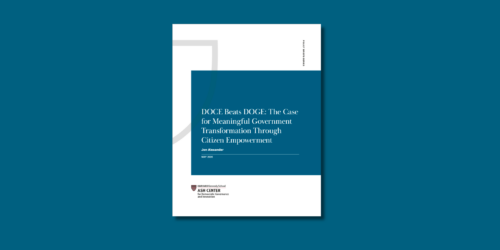
DOCE Beats DOGE: The Case for Meaningful Government Transformation Through Citizen Empowerment
A new policy brief by Jon Alexander, Non-resident Democracy Fellow at the Ash Center, argues for the development of a Department of Citizen Empowerment (DOCE) at all levels of government around the world.
DOCE Beats DOGE: The Case for Meaningful Government Transformation Through Citizen Empowerment
A new policy brief by Jon Alexander, Non-resident Democracy Fellow at the Ash Center, argues for the development of a Department of Citizen Empowerment (DOCE) at all levels of government around the world.
Artificial Intelligence and Democracy: Campaigns, Elections, Movements, and Deliberation
A new chapter in APSA Preprints by Archon Fung, Winthrop Laflin McCormack Professor of Citizenship and Self-Government and Director of the Ash Center, Bailey Flanigan, former postdoctoral fellow at the Ash Center and co-authors explores how generative AI is reshaping four dimensions of democratic practice—political campaigns, election administration, social movements, and citizen deliberation. The authors argue that AI’s ultimate democratic impact will depend less on the technology itself, and more on how institutions and leaders implement and regulate it.
A new paper in the Congressional Budget Office’s Working Paper Series, authored by Randall Akee—Director of the Project on Indigenous Governance and Development and Julie Johnson Kidd Professor at Harvard Kennedy School—along with his co-authors, draws on long-term administrative data to examine how immigrant workers’ earnings in the United States evolved between 1981 and 2021.
Bootstrap Blackness: Black Men, Conservatism, and Party Politics
A new research article by Dr. Christine Slaughter, Research Fellow at the Allen Lab for Democracy Renovation and co-authors examines the narrative of black men’s political “shift right”. The study finds Black men remain overwhelmingly Democratic, despite growing public attention to ideological divides.
Improving Election Administrator-News Media Relationships for Effective Election Coverage
This paper explores practical mechanisms for improving the relationship between election officials and news media to increase public confidence in the electoral process.
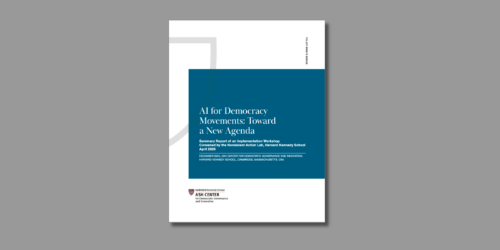
A new report summarizes key insights from the Nonviolent Action Lab’s December 2025 convening on how artificial intelligence can empower pro-democracy movements.
A summary of the March 30, 2026 event that welcomed Gerrit von Zedlitz to present on new and less-studied forms of targeted transparency—how they work, when they emerge, and whether they actually make a difference.
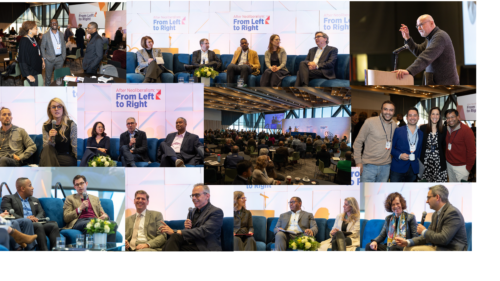
After Neoliberalism: From Left to Right brought together hundreds of leading economists, political scientists, journalists, writers and thinkers from across the political spectrum to explore and debate emerging visions for the future of the political economy.
The Necessary and Valuable Partnership: Law Enforcement and Election Officials
This report by Christine Cole, Kim Wyman, and Tina Barton examines the complicated historical relationship between voting and law enforcement in the United States, highlighting how policing experiences can influence public attitudes towards the presence of law enforcement at voting locations.