

Democracy and the Informed Public
The Roots of Democracy and the Informed Public: The Transparency Policy Project
Motivated by an increasing number of government policies rooted in mandatory information disclosure, Archon Fung, Mary Graham and David Weil co-founded the Transparency Policy Project (TPP) at the Harvard Kennedy School in 2001.
The TPP research team focused on diverse laws, regulations and requirements that draw on mandated disclosure to reveal information intended to achieve clear public policy goals. For example, nutritional labels, corporate financial disclosure, and automobile rollover labels attempt to reduce public risks. Mortgage interest disclosure requirements seek to use required disclosure on patterns of lending to induce banks to provide access to home financing to communities historically underserved by them. And policies like school report cards aim to improve educational performance by providing parents and communities with information on the quality of education provided by individual schools.
Though diverse in their aims, all these disclosure requirements share a set of core characteristics. They are rooted in achieving a clear public objective using public disclosure by corporations, organizations or individuals as a means of regulation. The policies do so by requiring standardized factual information, defined explicitly by those policies about specific products or practices.
The policies selected by the Transparency Policy Project researchers were the result of political compromise. They were often chosen because of perceptions that they provided common sense solutions, consistent with the idea that the public had the right and ability to have access to and use information. They also represented a means to address policy concerns in ways that gave regulated parties with strong economic interests a more politically acceptable avenue to address policy concerns than provided by traditional forms of regulation like technology or performance standards or liability rules.
By using a cross-policy lens to evaluate the policies, TPP researchers found that most cases of required disclosure failed to achieve their aims. Although the policy aims and methods differed across transparency policies, researchers found that a common set of factors made policy effectiveness highly demanding. Transparency policies fit into pre-existing “action cycles” that link information provided by disclosers—whether voluntarily or as mandated—to the decisions made by information users (the recipients of information) and the organizations required to provide it. This is depicted in the following diagram.
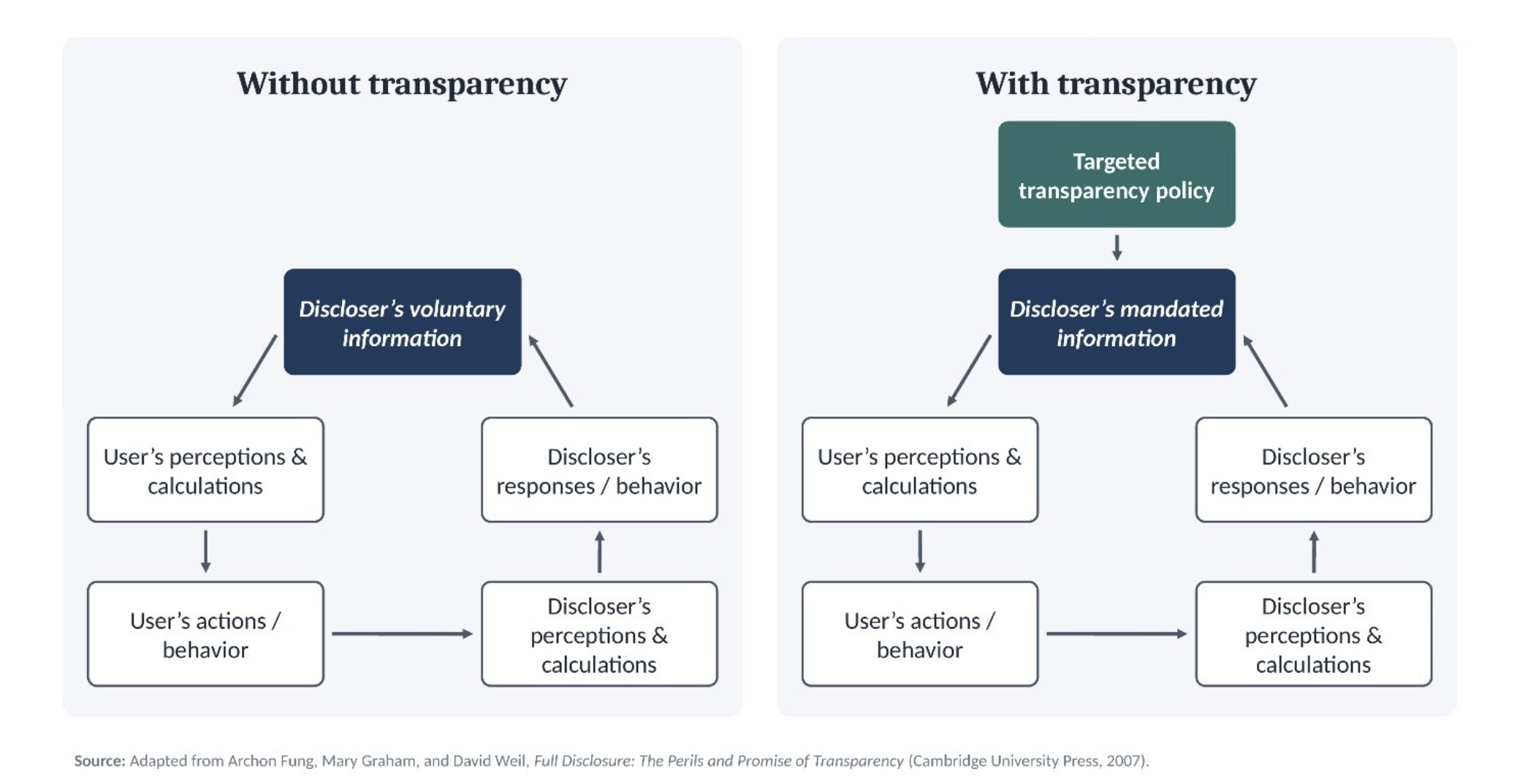
The action cycle framework recognizes that the intended beneficiaries of transparency policies (consumers, workers, citizens) typically have access to information voluntarily provided by disclosers that they may use in making choices (left side of the above diagram). In turn, the disclosers of that information make choices, such as in the safety of the products they sell or the quality of services they provide. Transparency policies (right side of the diagram) mandate that disclosers provide additional information—or information disclosed in a specific format—intended to lead users to make different decisions. Changed user choices then lead the disclosers to alter their decisions in response and in closer alignment with policy goals.
Yet evaluations of major disclosure policies reveal that simply providing information to users often proves insufficient to address policy objectives. To be effective, disclosed information needs to be accurate and in forms that are clear and available at the time customers, employees, investors, and citizens make choices. Those choices affected by new information, in turn, must be perceived by information disclosers and result in changes in disclosers’ decisions in ways that reduce risks or provide incentives to create or improve services.
Because of these demanding requirements, research from the Transparency Policy Project concluded that under most policies, mandated disclosure fails to achieve core objectives. At the same time, the analysis provided a clear framework by which policies could be improved or new policies developed that set them up for greater success.
Through research, publication of the influential book Full Disclosure, and evaluations of new policies, the Transparency Policy Project inspired related research and became part of policies adopted at the federal and state levels. Associated work around the world applied TPP ideas to areas like community-led accountability efforts in Indonesia, Tanzania.
The Transparency Policy Project’s frameworks and aims form the foundation of the Program on Democracy and the Informed Public.