Designing for Community Engagement: Toward More Equitable Civic Participation in the Federal Regulatory Process
The programs and rules that affect Americans’ daily lives and security are profoundly shaped by the regulatory and rule-making process within the Executive Branch of government.
To understand the advantages of and challenges to a reformed regulatory review process, New America’s Political Reform program and the Ash Center for Democratic Governance and Innovation at Harvard University’s John F. Kennedy School of Government convened a group of local community engagement experts, public sector leaders, and on-the-ground organizers to share their expertise in designing processes that support more inclusive engagement, in particular working with historically underserved communities.
During this discussion with local community engagement experts, we sought to identify the process designs and other innovations that would empower residents to exercise meaningful influence over decisions about the formation, review, and implementation of regulations. Our discussion focused on extending community engagement processes to give grassroots groups and affected parties a voice in the federal regulatory process.
These experts agreed that when engagement is designed intentionally, policymakers can work with communities more effectively to garner information and insights, implement programs or provide services, and build trusting relationships. Furthermore, while participation in and of itself is important, designing more effective engagement can also ensure that participants identify and harness opportunities to protect their interests and influence decision-making. And, most importantly, transparent and inclusive engagement practices can improve policy outcomes and strengthen equity.
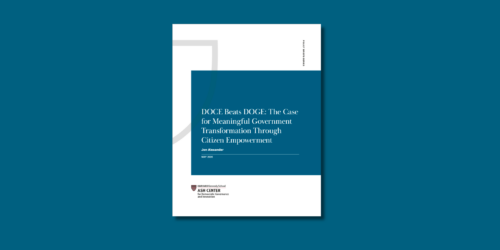
DOCE Beats DOGE: The Case for Meaningful Government Transformation Through Citizen Empowerment
A new policy brief by Jon Alexander, Non-resident Democracy Fellow at the Ash Center, argues for the development of a Department of Citizen Empowerment (DOCE) at all levels of government around the world.
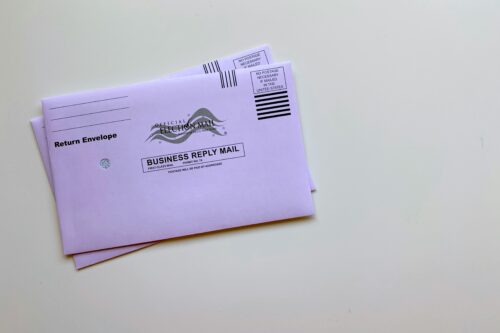
Allen Lab Fellow Hillary Lehr convened a Voter Experience Summit at Harvard’s Ash Center in March, bringing together 25 cross-sector experts to rigorously map the voter journey. This essay explores how that collaborative process could lay the groundwork for new interventions to understand and improve the experience of voting for all.
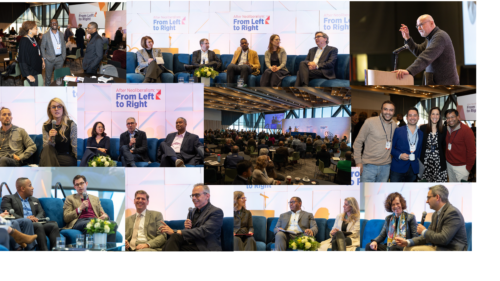
After Neoliberalism: From Left to Right brought together hundreds of leading economists, political scientists, journalists, writers and thinkers from across the political spectrum to explore and debate emerging visions for the future of the political economy.